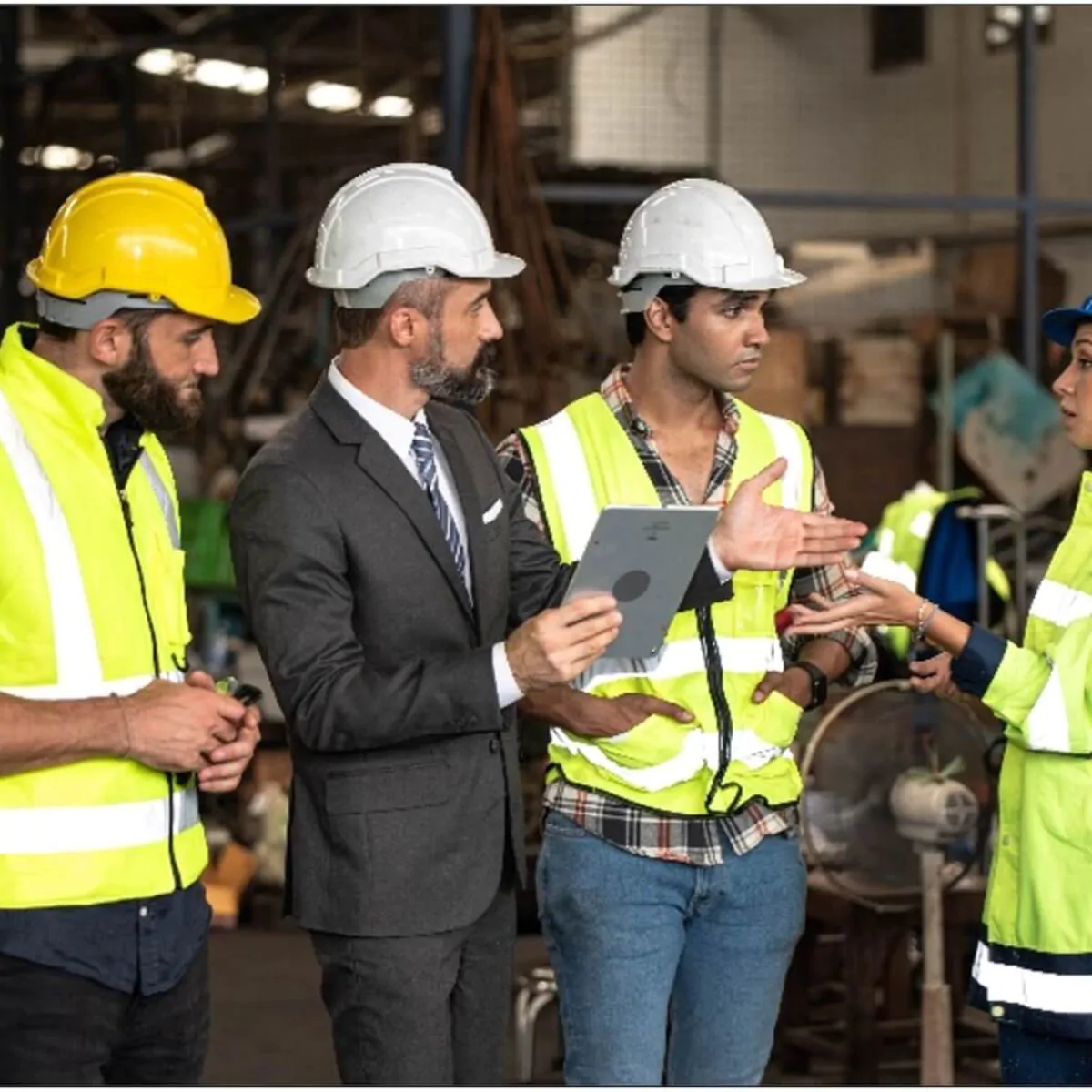
For a long time, health and safety management operated in two separate worlds. There was the physical realm of the workplace--the noise dust, the rumbling machinery, the exhausted workers making snap-of-the-brain decisions, and then there was this digital realm of reports, spreadsheets and compliance reports kept in distant offices. The two worlds seldom interacted. On-site assessments produced paper that evolved into digital information, however by the time this was complete, the working environment was different, the workforce were moving on and the findings were getting old. The entire safety system represents the splintering of this separation. It's about not digitizing processes on paper but about weaving digital intelligence into the framework of physical operations so that each hammer smack or near miss, every safety conversation generates data that helps improve the next safety. This is known as the ecosystem view and it affects everything.
1. The Ecosystem Covers Everything, Not Just Safety Systems
A real safety ecosystem doesn't stay separate from the other business systems. It connects with them. It gathers data from HR systems relating to training completion as well as new hire induction. It is linked to maintenance schedules to identify risk profiles of equipment. It also integrates with procurement to vet supplier safety performance before signing contracts. When on-site tests are carried out, auditors and consultants see more than only a few safety statistics, but the entire operational context. They know which machines are due for service, which crews are currently in turnover, and who has a poor history elsewhere. This holistic analysis transforms estimates by transforming snapshots into comprehensive contextual insight.
2. On-Site Assessors become Data Nodes, but not Data Entry Clerks
In traditional models, the on-site assessor's primary job was data collection--observing conditions, interviewing workers, recording findings for later analysis elsewhere. In the whole ecosystem, assessors are Data nodes, connected to an ever-growing network. They provide real-time dashboards to operations managers the safety committees, the operations manager, and executive leadership in a single. An incident involving inadequate security on a presses brake does do not wait for a written report to be written or circulated; it appears instantly on the maintenance director's work list and in the plant's weekly review. The assessor remains in the loop, constantly consulted until the issues are resolved rather than being discarded when the report is completed.
3. Predictive Analytics shifts focus from Past to Future
Ecosystems that incorporate historical assessment information with current operational data can provide an ability to predict which is impossible for siloed systems. Machine learning models discover pattern patterns that are associated with incidents--certain combinations circumstances, specific times of the morning, certain crew combinations--that human observers could miss. If consultants conduct on-site assessments that are conducted, they bring these predictions, knowing when risk is statistically likely to be the greatest and focusing their on that area of the risk. This assessment shifts focus from documenting the incidents that have already occurred and preparing for what might take place next.
4. Continuous Monitoring replaces periodic checking
The notion of an "annual assessment" gets obsolete when you have a total ecosystem. Sensors, wearables, and connected tools provide an endless stream of safety-related data: air quality measurement, equipment vibration patterns and worker locations and changes in movement, levels of noise, temperature and humidity. Assessments on the spot by humans are vital however, their role has changed: instead of reviewing conditions at a single moment in time analyze patterns in the continuous data analysing anomalies, verifying measurements from sensors and studying what the stories are behind the figures. The pace shifts from regular monitoring to continuous.
5. Digital Twins Enable Remote Assessment and Plan
Modern ecosystems include digital twins - virtual copies of physical workplaces that simulate real-time working conditions. Safety professionals can explore facilities from the comfort of their homes, checking digital representations of current equipment status, recent incidents, ongoing maintenance and work activities. This service proved beneficial in the face of travel restrictions for pandemics, but will prove invaluable to businesses across the globe. Consultants can conduct preliminary assessments remotely and later deploy on site only in cases where physical presence can add an added value. Travel budgets are able to be stretched further as response times diminish, and experts reach more places quicker.
6. Worker Voices are directly integrated into Assessment Data
The biggest difference in traditional assessments of safety has always been from the worker viewpoint. By the time observations reach assessors, they have passed through multiple filters--supervisors, managers, safety committees--that smooth away discomfort and dissent. Full ecosystems of support include specific channels for input from workers as well as simple mobile tools to report issues as well as anonymous hazard reports integrated with assessment procedures, and analysis of safety conversation patterns of team meetings. As soon as assessors arrive on the site, they already know the conversations that workers have had which allows them to confirm pattern patterns and explore further specific issues rather than beginning all over again.
7. Assessment Findings Auto-Populate Training and Communication
In isolated systems, an evaluation of safety issues with forklifts could result in a recommendation for training. A person is then required to plan the training, communicate with those affected, record success, and test for effectiveness. All separate tasks requiring separate effort. In a full ecosystem, assessment findings create automated workflows. If an assessor detects some pattern of forklift close-misses, the system automatically identifies the operators who have been affected and schedules refresher education, adds forklift safety to any toolbox talk agenda and then notifies supervisors to intensify their observation. The data does more than be recorded in a report, it generates action throughout connected systems.
8. Global Standards Adapt to Local Reality Through Feedback Loops
Global safety standards frequently fail due to their centralization as well as imposed locally without adjustment. Complete ecosystems create feedback loops and solve this problem. Because local assessors make use of global software frameworks to analyze their findings, their conclusions or modifications and workarounds feed back to central standard-setters. Certain patterns emerge. This can cause issues in tropical climates. as the control measure cannot be used in specific regions. This definition confuses people across many sites. Central standards evolve based on this operational intelligence, and become more robust and more appropriate every assessment cycle.
9. Verification is Continuous, Not Periodic
Regulators, insurers, and corporate auditors have historically relied on periodic verification--inspecting records at fixed intervals to confirm compliance. Comprehensive ecosystems make it possible to verify continuously through secure, restricted access to data that is live. Parties with authorization can access present safety statuses, recent assessment results, as well as correctional action progress without waiting the annual audit reports. This transparency helps build trust and reduces burden for audits, as constant visibility eliminates need for a series of periodic audits. Organizations show their safety performance through ongoing activities, rather than just periodic performances for auditors.
10. The Ecosystem Expands Beyond Organizational Boundaries
Safety ecosystems that are mature extend beyond the organization itself to include suppliers, contractors customers, and nearby communities. When they conduct assessments on site they take into account not only security of employees but also safety for the public, environmental impact, and relationships between supply chain partners. Data shared securely across organisational boundaries enables coordinated risk management--construction sites know when nearby schools have activities that affect traffic patterns, manufacturers know when suppliers have safety issues that might disrupt production, communities know when industrial activities create temporary hazards. The ecosystem is then truly complete including all who are affected through the operation of an organisation and not only those employed by it. Read the most popular health and safety assessments for blog info including health safety and environment, job safety assessment, workplace hazards, safety topics, safety certification, hazards at work, workplace safety training, occupational health and safety jobs, safety precautions, safety companies and most popular health and safety assessments for website info including work safety, safety day, workplace safety training, safety moment ideas, consultation services, workplace safety courses, smart safety, safety officer, hazards at work, occupational health and safety jobs and more.

This Is Future Of Workplace Safety: Merging On-The-Ground Expertise With Global Tech Solutions
The safety industry is at an intersection point. Since the beginning of time, progress included better engineering controls better training and more rigorous enforcement. These are essential methods however, they've reached low returns in various industries. The next major leap forward will not be a result of a single invention, but rather from the combination of two skills that have historically developed in isolation and the profound contextual wisdom of experienced safety specialists who know the specific requirements of workplaces and the analytical power of global technology platforms that are able to analyze huge amounts of data and discover patterns that are unnoticed by any individual. This merger isn't about replacing human intelligence with algorithms. It is about augmenting the human judgement through machine learning, so that the safety professional on the ground becomes more effective, more accurate, and more influential in the workplace than they have ever been. In the future, workplace safety belongs only to those who combine these worlds with ease.
1. the limits of Purely Technological Approaches
The tech industry has regularly claimed that software alone will be able to solve the issue of workplace safety. Sensors could spot hazards and algorithms could anticipate incidents AI would advise workers on what to be doing. These promises have consistently failed since safety is a fundamentally human problem. It is a matter of human behavior, human judgement, human relationships and human outcomes. Technology can inform and enable, but it cannot replace the nitty-gritty understanding of an skilled safety professional can bring to the workplace. The future is in integration and not to replacement.
2. Beyond the limits Purely Human Approaches
Similarly, human-centered strategies have reached their limit. Even the most skilled safety professional can only observe enough, recall an inordinate amount, and connect numerous dots. Human judgment is subject to fatigue, bias, and the limitations of an individual's perspective. There is no one who can keep in their mind the patterns emerging on a variety of sites and the most prominent indicators that were able to anticipate other incidents, or the changes to regulations that affect industries that they don't personally follow. Technology expands human capacity beyond these limits naturally, providing the ability to remember patterns, memory, and global awareness that enhance rather than substitute for professional judgement.
3. Predictive Analytics reveals where to Go
The most powerful use of combined capabilities is predictive analytics that tells experts on-the-ground where to focus their efforts. The software analyzes past incident data, near miss reports, audit findings, and operational metrics to discover places, activities, and situations that can be considered to be risky. The safety professional investigates these scenarios, applying human judgement to discover what the numbers mean within their context. Are the risks predicted to be real? What are the driving factors behind them? What interventions make sense here due to the local context and the culture? Technology makes points; the human makes the decision.
4. Sensors and wearables generate continuous Data Streams
The emergence of wearable devices and environmental sensors creates continuous streams of safety-relevant data that would be impossible for a human to gather. Heart rate variation that indicates worker fatigue. Monitoring of air quality for hazardous exposures. Location tracking helps identify unauthorised access to dangerous areas. Motion sensors detecting slips or falls. All platforms across the world aggregate this information across sites and regions in order to detect patterns that merit personal attention. Experts in the field then examine sensors, confirming their readings taking into account context, and then deciding on the most appropriate response. The sensors collect the data The humans interpret the context.
5. Global Platforms Allow Local Benchmarking
Safety professionals have long wondered how their performance compared to their colleagues, yet meaningful benchmarks weren't always available. Global technology platforms improve this, by aggregating non-anonymised data across various industries and regions. A safety manager in Malaysia is now able to view how their incident rates their audit findings, incident rates, as well as leading indicators compare to comparable facilities within their region and globally. This benchmarking informs priority-setting and provides evidence for resource requests. If local experts are able to demonstrate that their performance lags regional peers, they gain credibility for investing. When they are leading the way, they gain respect and acknowledgement.
6. Digital Twins Allow Remote Expert Consultation
Digital twin technology -- which allows for virtual replicas of workplaces in real time that are updated with real-time updates-- creates a new model of expert consultation. When a safety expert on-site encounters a problem that is complex and needs to be connected remotely with experts in the field who are able to explore the digital model, study relevant data, and provide guidance without having to travel. This capability democratises access to experts, allowing facilities located in remote locations or those with developing economies to access expert knowledge that would otherwise not be available or affordable.
7. Machine Learning Identifies Leading Indicators
The traditional safety metrics are entirely lagging--they tell you how many incidents have occurred. Machine learning applied to integrated data sets is increasingly adept at identifying key indicators that are able to predict future incidents. Variations in the patterns of near-miss reports. Variations in the types of observations made during safety walks. It is possible to observe a delay between hazard identification as well as correction. These indicators of leading importance, analyzed by algorithms, are focal points for on-the-ground experts that can analyze what's driving the change and intervene prior to incidents occurring.
8. Natural Linguistic Processing Extracts Insight from Unstructured Data
The majority of relevant safety information is found in unstructured documents, including investigation reports, safety meeting minutes, notes of interviews, emails, and so on. Natural language processing tools within integrated platforms allow for the analysis of this text at scale, identifying themes, sentiment changes, and emerging issues that no human reader could be able to aggregate. If the software discovers that employees from multiple locations are expressing similar frustrations about a specific procedure The system informs local and world experts who will investigate what the procedure actually requires modification, rather than only local enforcement.
9. Training becomes more personalised and adaptive
The fusion of locally-based expertise combined with modern technology facilitates training that is adapted to requirements of the worker. The platform tracks each worker's duties, work experience, incident timeline, and even the completion of their training. When certain patterns suggest specific knowledge absences in workers with certain roles, who are regularly have been involved in specific types of incidents--the system suggests specific courses of action. Local experts review these recommendations, changing the content to fit the context, and supervise the delivery. Training becomes continuous and personalised instead of a series of generic and periodic, addressing actual needs as opposed to preconceived expectations.
10. The Safety Professional's Role Inspires
The most significant outcome of this merger is the elevation to the level of the safety officer's position. In the absence of data collection and reports generation tasks that software takes care of better specialists on the ground concentrate on more lucrative tasks such as building relationships people, understanding operational realities, designing effective interventions, as well as influencing culture in the workplace. Their judgment becomes more valuable because it's informed by details they could not have collected themselves. Their opinions are more dependable due to their reliance on facts that go beyond personal knowledge. The workplace safety professional of the future is not apprehensive about technology but empowered by it - more experienced, more influential and more effective than ever before. View the recommended health and safety consultants for site advice including safety inspectors, consultation services, workplace hazards, health hazard, worker safety training, risk assessment template, health & safety website, hazard identification, safety moment, occupational health and safety jobs and more.